The Visual Mantra: See Your Way Through


In many of my previous posts, we’ve talked about the importance of self-awareness, recognizing our needs, and learning to pause before we react. When we do this well, we give ourselves the opportunity to choose intention rather than simply operating on emotional autopilot. But, let’s be honest, even when we know the tools, certain environments can still catch us off guard.
A social gathering where we feel out of place. A work meeting where the stakes feel high. A family gathering where old patterns tend to reappear. A competitive event where pressure creeps in.
In these moments, it’s not uncommon for people to experience angst, disconnection, dissociation, mood shifts, avoidance, isolation, or other behaviors that move us further away from the version of ourselves we were hoping to bring into the room.
Here is a tool for this, I call it The Visual Mantra.
What Is a Visual Mantra?
Most people are familiar with the idea of a mantra, a phrase repeated to help calm the mind, increase focus, and bring ourselves back to center.
A Visual Mantra works in a similar way, but instead of repeating words, we briefly picture ourselves moving through a situation in a grounded and intentional way.
We visualize the environment.
We visualize the interaction.
Most importantly, we visualize how we want to show up.
This is not about fantasy or inflating expectations. We are not trying to create an unrealistic script where everything goes perfectly. That would only set us up for disappointment.
Instead, the Visual Mantra is about centering ourselves before we enter the moment.
It allows us to ground ourselves in a mental image of intention, a reminder of how we want to respond rather than react.
The goal is not perfection. The goal is presence.
Why This Tool Matters
Our minds are incredibly adept at rehearsing negative outcomes.
Before we walk into a room, we may already be imagining awkward interactions, conflict, embarrassment, or failure. When we rehearse those scenarios repeatedly, our bodies often respond as though the threat is real.
The result?
We may enter the situation guarded, withdrawn, defensive, or avoidant.
The Visual Mantra interrupts that process.
Instead of rehearsing distress, we rehearse grounded participation.
We give our nervous system a different reference point.
Using a Visual Mantra in a Social Setting
Imagine you’re attending a social gathering where you don’t know many people.
In the past, you might find yourself standing near the wall, scrolling your phone, or leaving early because the discomfort begins to build.
Before entering the room, pause.
Picture yourself walking in. You see yourself greeting the host; maybe you introduce yourself to someone nearby. Perhaps you ask a simple question and allow the conversation to unfold naturally.
You’re not imagining becoming the life of the party. You’re simply visualizing yourself remaining present instead of retreating.
When the moment arrives, your mind already has a reference point: This is how I move through the room.
Using a Visual Mantra in a Work Environment
Work environments can easily trigger self-doubt.
Maybe you’re about to present an idea, contribute in a meeting, or speak with a supervisor about something important. Without intention, many people mentally rehearse everything that could go wrong.
Instead, try a Visual Mantra.
Picture yourself sitting calmly in the meeting. When it’s your turn to speak, you take a breath and express your thoughts clearly. If someone disagrees, you remain steady and curious rather than defensive.
Notice the difference here.
The visualization is not about everyone applauding your idea, it’s about you maintaining composure and clarity.
The success is not the outcome. The success is in your participation and presence.
Using a Visual Mantra at a Family Gathering
Family gatherings often carry emotional history.
Old roles and expectations sometimes resurface quickly, even when we’ve been doing meaningful work on ourselves. Before arriving, picture the setting.
See yourself greeting people. Imagine sitting at the table. If a comment arises that might normally trigger frustration or defensiveness, visualize yourself pausing before responding.
Maybe you redirect the conversation.Maybe you respond calmly.Maybe you choose not to engage in a familiar pattern.
The Visual Mantra is not about controlling the family dynamic. It is about protecting your own regulation and self-awareness within it.
Using a Visual Mantra in a Physically Competitive Event
This tool also applies to physical performance.
Athletes frequently use visualization because the brain often prepares the body for what it anticipates. Imagine you are preparing for a race, stepping onto a field, or entering a competition.
Picture yourself focusing on your breathing. You feel your body moving steadily and intentionally. When fatigue arrives, as it inevitably will, you see yourself continuing with determination rather than panic.
The visualization isn’t about standing on a podium. It’s about remaining present within the effort.
When the moment comes, your body is not meeting the challenge for the first time. Your mind has already rehearsed the experience of staying engaged.
A Final Thought
The Visual Mantra is not meant to eliminate challenges.
Life will still present uncomfortable moments, unexpected interactions, and imperfect outcomes.
What the Visual Mantra offers is something simpler and more valuable, a way to orient yourself before stepping into the moment.
Instead of entering situations already bracing for distress, give yourself a brief opportunity to remember who you want to be in that space, and who you are:
Calm.
Aware.
Intentional.
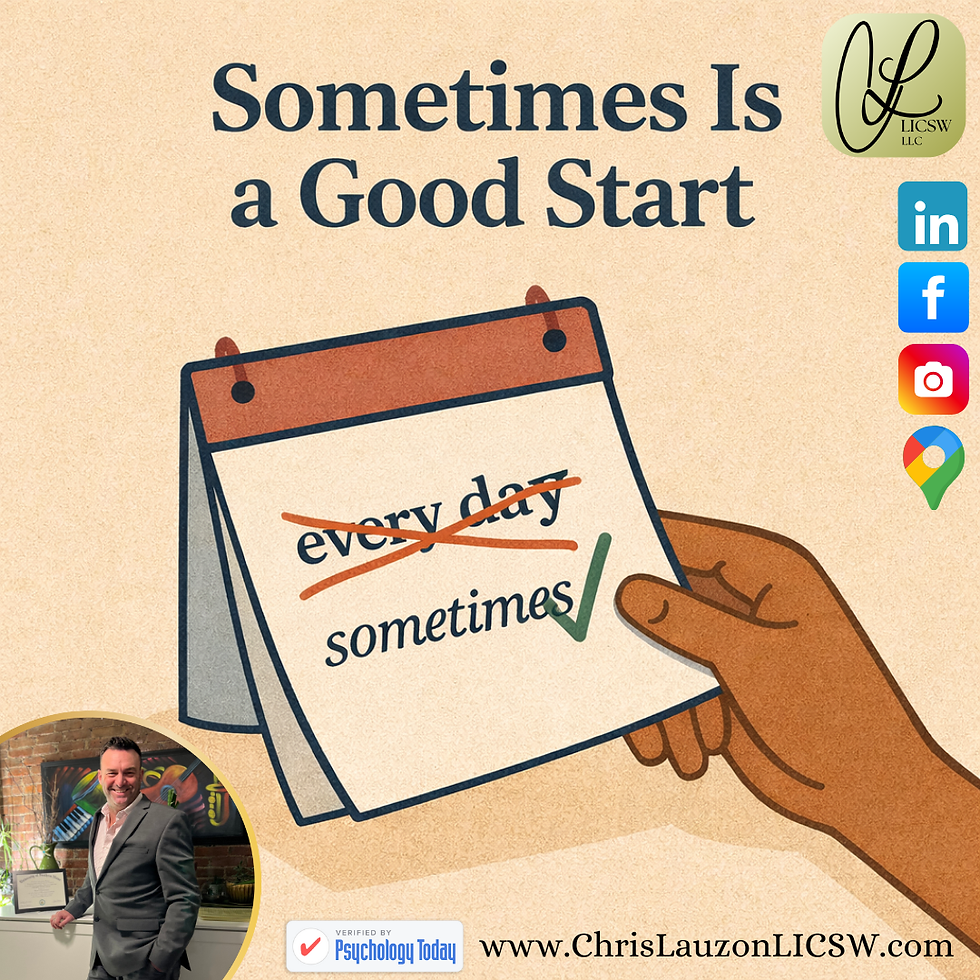
And if you only remember to use the tool sometimes? That’s okay. As we’ve explored before, growth rarely begins with perfection.
“Sometimes” is a good start.
Chris Lauzon, LICSW
Therapist
Boston, Massachusetts